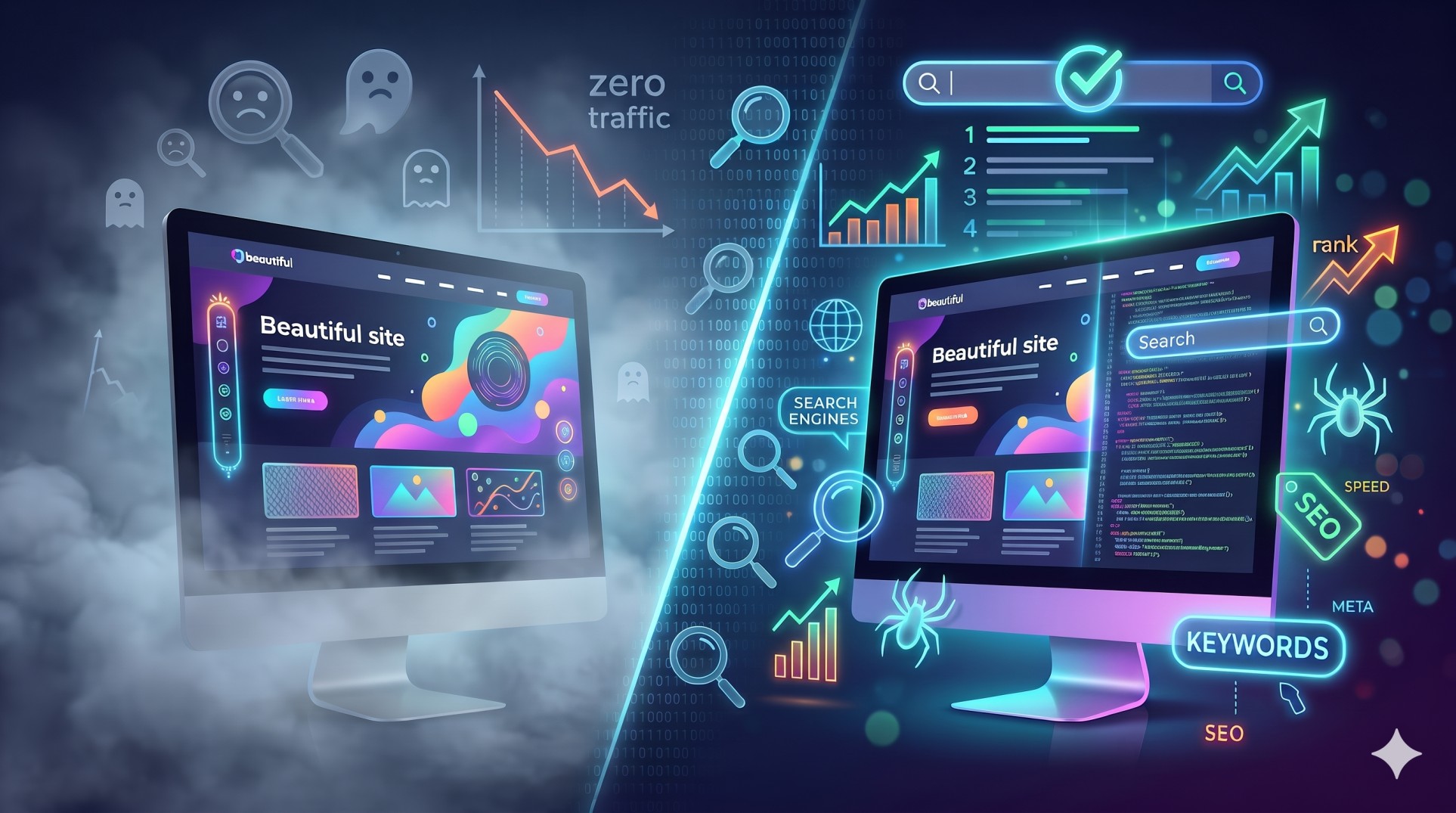
You invested in the brand. The logo is sharp, the typography is considered, the photography is beautiful, and the website finally feels like you. Then the enquiries don't come.
You search for what you do, and your site is nowhere on page one. Competitors with clunky, dated websites sit above you. It feels unfair, and honestly, it is a little unfair. But it is also very fixable.
As a creative agency, we see this story more than any other. Brands spend months perfecting how they look and almost no time on how they are found. Search engines don't see your colour palette or your hero animation. They read code, content, and signals of trust. If those are missing, even the most beautiful website in London stays hidden.
This guide walks through the seven most common reasons design-led websites fail to rank, and how to fix each one without stripping out the design that makes your brand worth noticing. If you would rather have someone look at it for you, our SEO services in London start with a transparent audit.
Design-led sites love short, poetic headlines. "Crafted with care." "Spaces that breathe." They look lovely in a large serif font, but nobody types them into Google.
Your audience searches in plain language: "interior designer Islington", "branding agency for SaaS startups", "wedding florist south London". If those phrases never appear in your headings and copy, search engines have very little to connect you to them. You can keep the brand voice. You just need the H1, the opening paragraph, and at least one subheading on each page to say what you do and where.
A portfolio site is often 90% imagery. That works for human visitors, but search engines need text to understand what a page is about. A project page with six photos and one line of caption gives Google almost nothing to rank.
Add a short write-up to each project: the client, the brief, the challenge and the outcome. Two or three paragraphs is enough to turn a gallery into a page that can rank for the type of work you want more of.
Full-width hero videos, uncompressed photography, Lottie animations and scroll effects all add weight. Page speed and Core Web Vitals are part of how Google judges page experience, and slow sites also lose visitors before the page has even loaded, especially on mobile.
The fix rarely means removing the visuals. It usually means compressing images, serving modern formats like WebP or AVIF, lazy loading anything below the fold, and making sure animations don't block the main content from appearing.
Alt text describes an image for screen readers and for search engines. On many design-led sites it is blank or filled with file names like "IMG_4821_final_v3". That is a missed chance for accessibility and for image search.
Write a short, honest description of each meaningful image. "Brand identity for a Shoreditch coffee roaster, shown on takeaway cups" helps everyone. Purely decorative images can stay empty.
Hamburger menus on desktop, hover-only links, single-page scroll layouts and pages linked only from buttons inside sliders can all make it harder for search engines to discover and understand your content.
Every important service should have its own page, reachable through a normal text link, ideally from the main navigation and the footer. If your brand, web design and SEO all live on one long page, they compete with each other instead of ranking on their own.
Platforms like Webflow, Squarespace and Framer make it easy to launch a gorgeous site quickly. They also make it easy to skip the settings that matter for search: unique page titles, meta descriptions, clean URLs, an XML sitemap, canonical tags, redirects from old URLs, and structured data.
None of these are visible on the page, which is exactly why they get forgotten. They are also some of the quickest wins in any audit.
Search engines look at what the rest of the web says about you. Reviews, a complete Google Business Profile, mentions in industry press, links from partners, and consistent business details across directories all build credibility.
A new website with no external footprint is like a beautiful shop on a street nobody walks down. We cover how brand reputation feeds into this in Does Branding Affect SEO?
Good SEO and good design want the same thing: a site that is clear, fast, and easy to use. The trick is building search into the design system rather than bolting it on afterwards.
This is the same approach behind our SEO services: practical, transparent and analytical. We look at what your audience is searching for, make sure the site is technically sound and refine content so it speaks to both humans and algorithms. If content planning is where you are stuck, our guide to brand content strategy is a good next read.
For studios, clinics, cafes, salons and service businesses across London, the map pack often matters more than the main results. When someone searches "[your service] near me", Google shows three local listings before most websites appear at all.
A beautiful website helps you convert those visitors, but your Google Business Profile is what gets you into that top three. The essentials:
We go deeper on profile posts in Should you post on Google Maps? If you serve several boroughs or cities, dedicated location pages with genuinely useful, specific content can help you show up beyond your immediate postcode.
More people now ask ChatGPT, Gemini, Perplexity or Google's AI Overviews for recommendations before they ever click a link. These tools can only recommend brands they can read and understand.
That makes the gaps above even more costly. A site that is mostly images, with vague headlines and no clear description of its services, gives AI tools very little to work with. The brands that get cited tend to have:
The good news is that the work overlaps almost completely with good SEO. We explain the shift in more detail in From SEO to AEO.
Run through this list on your own site. Each "no" is a place where visibility is leaking.
Technical fixes like titles, speed and indexing can show movement within weeks. Content and authority build more slowly, and meaningful growth in rankings and enquiries usually takes three to six months, depending on competition. That is why we treat SEO as something that compounds over time, not a quick hack.
New sites can take a few weeks to be crawled and indexed. If it has been longer, check that the site isn't blocked from search engines in its settings, that a sitemap has been submitted through Google Search Console, and that each page has unique titles and enough text to rank.
Not by itself. The problem is visuals without supporting text, structure and optimisation. A highly visual site can rank well if images are compressed, described with alt text and paired with clear, useful copy.
It can if URLs change without redirects, content is removed, or technical settings are lost in the move. Planning SEO into the redesign from the start protects existing rankings and often improves them.
Yes. Webflow gives you control over titles, meta descriptions, alt text, redirects, sitemaps and clean code. Like any platform, it only performs well when those settings are actually used.
Organic SEO helps your website rank in the main search results for the topics and services you offer. Local SEO focuses on nearby searches and the map pack, mainly through your Google Business Profile, reviews, and location signals. Most London businesses benefit from both.
You have already done the hard part by building a brand worth noticing. SEO makes sure the right people actually find it.
At Curious Brand, we started offering SEO because we kept meeting brilliant brands that were hidden online. Our SEO services in London cover organic and local search, with transparent audits, continuous refinement, and monthly reporting that actually makes sense.
Ready to get seen and found? Get your visibility plan, and we will show you exactly where your site is leaking visibility and how to fix it.