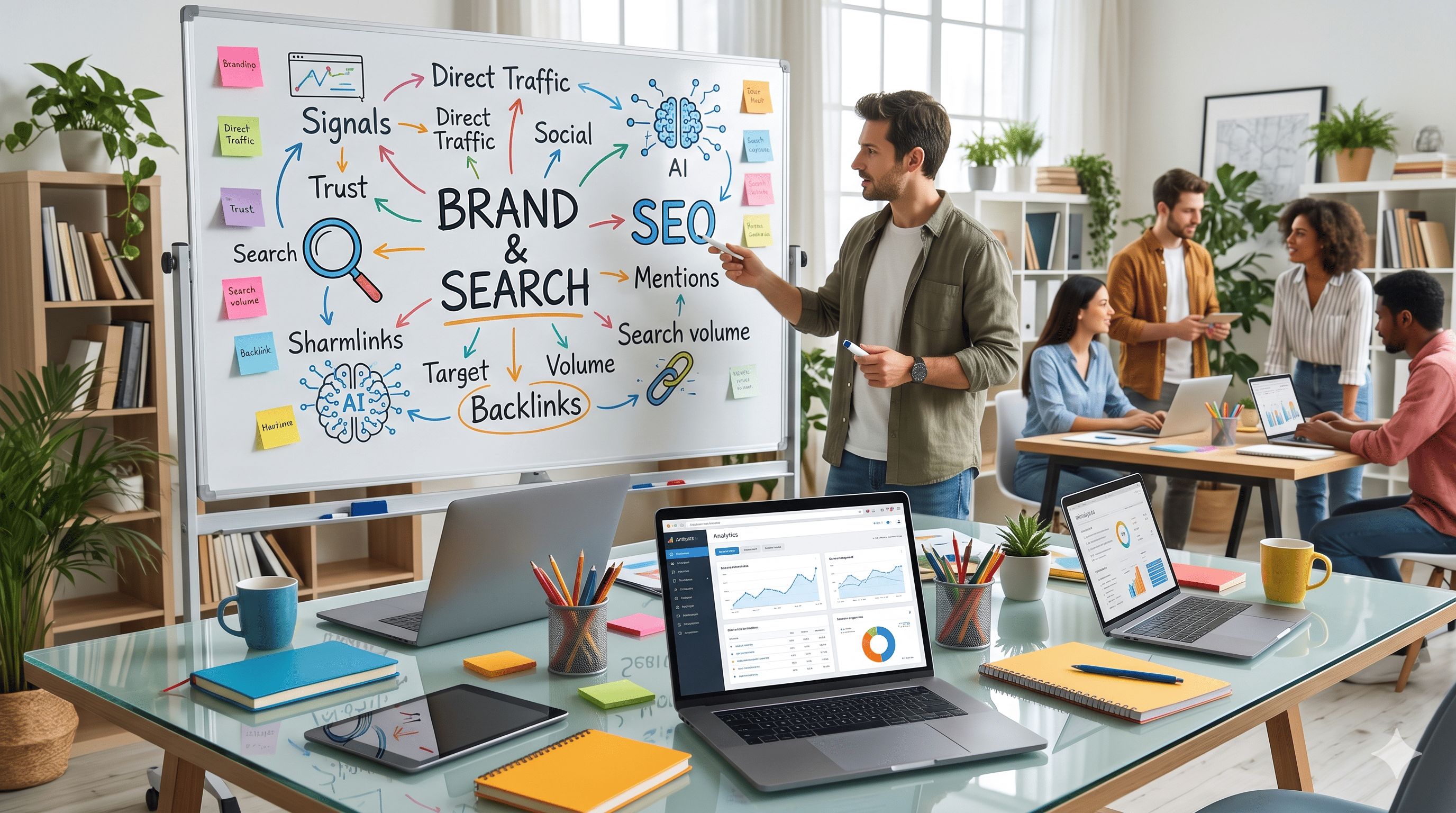
Branding is not a ranking factor you can switch on, but it shapes almost everything search engines and AI tools learn about you. Google does not publish a brand score that rewards a good logo. What it does measure is behaviour: whether people search for you by name, click your result when they see it, and come back.
AI assistants rely on a related signal: how often and how consistently your brand is mentioned across the web. So the honest answer is that branding affects SEO indirectly, and the indirect effect is large.
This post separates what is proven from what is only plausible, then turns it into steps you can act on. If you want brand and search planned together, that is the work behind our SEO services.
A brand signal is any trace showing that real people know, look for, and trust a brand. Search engines cannot judge how good your logo is, but they can see how people interact with it. This is also the corner of SEO where correlation is most often mistaken for proof, so the table grades each signal by how well the evidence supports it.
Big brands simply have more of everything, including more mentions, more branded searches and more links. That is why a correlation does not prove that adding one of them will lift the others. The Ahrefs authors say the same about their own study.
Branded searches and clicks are the strongest link. Testimony in the US antitrust case against Google confirmed a system called Navboost that adjusts rankings using click behaviour. Commentary on the 2024 API leak suggests it gives weight to navigational queries, which are searches that include your brand name followed by a click on your result. Nobody outside Google knows the exact weighting, so treat this as a direction, not a formula.
Mentions without links are a weaker story. In a 2021 Office Hours, John Mueller said Google does not use plain mentions for PageRank or for understanding a site's link graph, and called them too ambiguous to work as a clear signal. He added that mentions can help indirectly, because people who hear about you may search for your name. That indirect route is the one that matters. The long-running idea of implied links comes from a patent that actually describes brand searches, which it calls reference queries, and not mentions on other sites.
You can now see this in your own data. Google added a branded queries filter to Search Console in November 2025. Splitting branded from non-branded clicks is the simplest way to tell whether brand demand is growing.
The practical reading is that classic SEO rewards brands people go looking for, and that demand cannot be bought with markup.
AI answers lean on brand more heavily than classic results do. Ahrefs studied 75,000 brands and compared a range of signals with how often each brand appeared in ChatGPT, Google AI Mode and AI Overviews.
Source: Ahrefs, 75,000 brands, December 2025.
Two cautions apply. First, these are correlations, and the same big brands appear across all three assistants. Second, a mention is not a citation. A Semrush study, as reported by LSEO, found that 61.7% of observed citations used a page without naming its brand.
The platforms also differ. Ahrefs found AI Mode rewards established brands most, while ChatGPT looks less gated by classic authority, which makes it the easier entry point for a smaller brand.
AI tools also need to be sure who you are. Organization schema with sameAs links to your official profiles gives them a clean way to match your site to your LinkedIn, Wikidata or Crunchbase entries. It helps recognition, but it does not guarantee a knowledge panel or a citation.
Finally, results move around. SparkToro found less than a 1 in 100 chance of getting the same brand list twice from ChatGPT, so measure visibility as a rate across many prompts, not as a rank.
Visual identity does not move rankings on its own. What it can do is make the signals above easier to earn. This section is practical reasoning from how those signals work, not a measured ranking factor.
If your identity is changing, the risk sits in the details: names, URLs and page titles. For a look at a major identity change from a design view, see our post on Channel 4's new logo and identity.
Not as a named factor. Brand shows up indirectly through branded searches and clicks, which Google's click-based systems appear to use.
Google's John Mueller said in 2021 that Google does not use plain mentions for link purposes. They can help indirectly by sending people to search your name, and they correlate with AI visibility.
Not directly. The risk comes from changes that travel with a redesign, such as new names, URLs, and page titles.
Track branded and non-branded clicks in Search Console, branded search trends, and how often AI tools mention your brand across a fixed set of prompts.
The data points that way. Ahrefs found brand mentions correlate far more strongly with AI visibility than links or page count do, although that is correlation, not proof.
Brand and search work best when they are planned as one job. If you want a team that treats identity, content and visibility as a single system, explore our SEO services or get in touch.