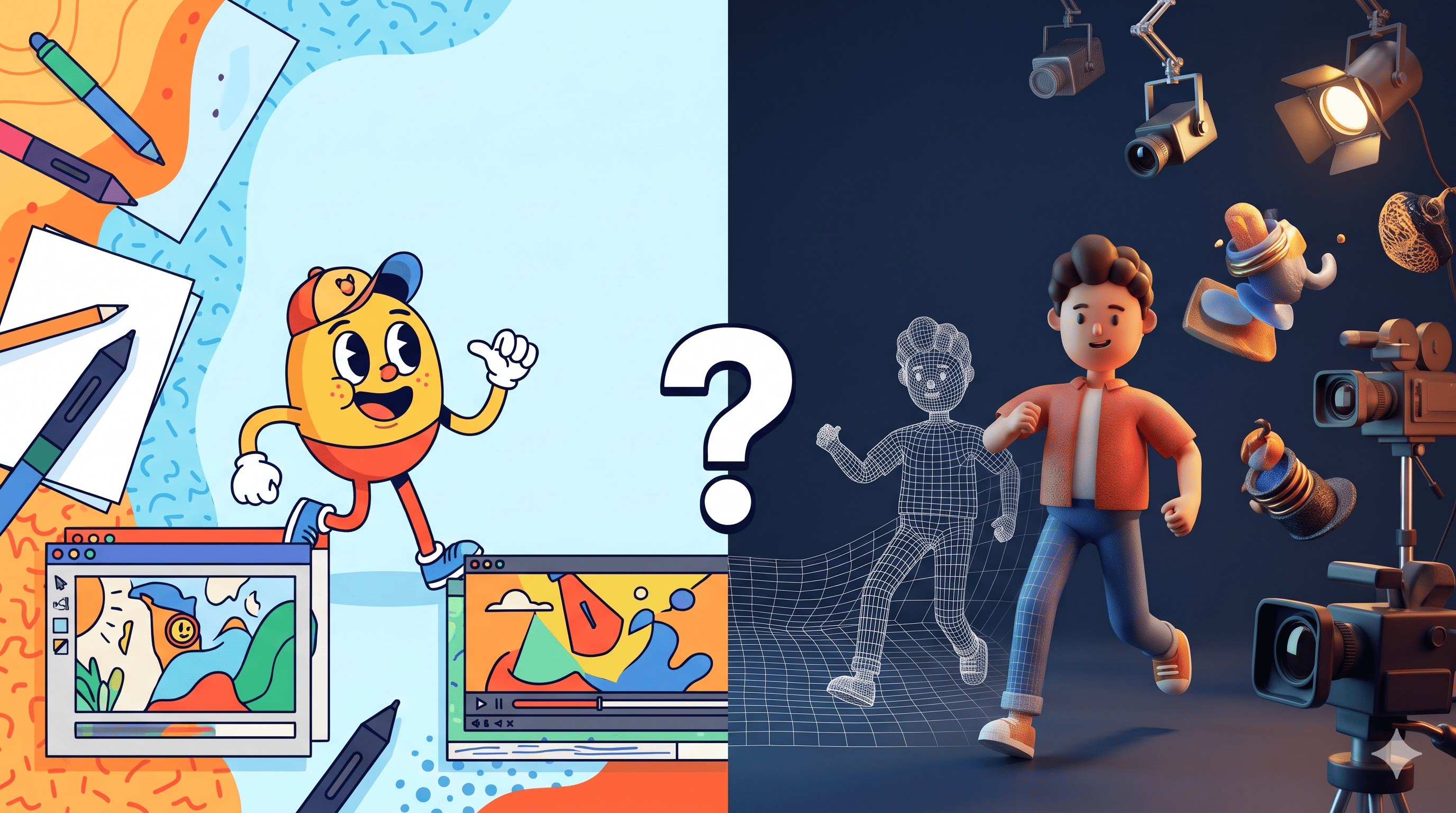
2D vs 3D Animation: Which Is Right for Your Brand?

Choosing between 2D and 3D animation is one of the first decisions in any animated video project. It shapes your budget, your timeline and the way your audience feels when they watch. Pick the wrong one and you can end up paying for detail nobody needed, or telling a product story with visuals that cannot show the product properly.

‍

This guide explains what 2D and 3D animation are, how they differ, where each one works best, and how to decide which fits your brand. If you are still scoping the wider project, our video motion design service page shows how we approach animation from concept to delivery.

‍

What Is 2D Animation?

‍

2D animation creates movement in a flat space, using width and height only. Characters, shapes, icons, illustrations and text are drawn or built as flat artwork and then animated across the screen. Most explainer videos, animated infographics, kinetic typography pieces and social media motion graphics are 2D.

Common 2D styles include:

  • Motion graphics: animated shapes, icons, charts and typography, often used for explainers and data stories.
  • Character animation: illustrated characters that move, talk and act out a story.
  • Flat or vector animation: clean, graphic artwork with simple movement, popular for SaaS and corporate videos.
  • Hand-drawn or frame-by-frame animation: each frame is drawn individually, giving a more organic, crafted look.
  • Cut-out animation: layered artwork moved and rigged digitally, a practical middle ground between hand-drawn and vector styles.

‍

What Is 3D Animation?

‍

3D animation works in a three-dimensional digital space, adding depth to width and height. Objects and characters are modelled as digital forms, given textures and materials, lit like a film set and filmed with a virtual camera. That means the camera can orbit a product, move through a space or reveal details from any angle.

A typical 3D production includes these stages:

  1. Modelling: building objects or characters in 3D.
  2. Texturing and materials: adding colour, surface detail and finish.
  3. Rigging: building a skeleton or controls so models can move.
  4. Animation: setting the movement.
  5. Lighting and camera work: shaping mood and focus.
  6. Rendering: producing the final frames, which can be time-intensive.

Because 3D has more stages, it generally needs more production time and specialist skills than a comparable 2D piece.

‍

2D vs 3D Animation at a Glance

‍

Video Type Often Suits Why
Explainer Video 2D Simplifies ideas and keeps the message clear.
SaaS or App Walkthrough 2D or Hybrid Interface highlights and abstract concepts are easy to show in 2D.
Product Demo or Reveal 3D Shows form, materials and function from any angle.
Corporate or Brand Story 2D, 3D or Hybrid Depends on the tone: warm and illustrative, or cinematic.
Social Media Content 2D Fast to produce, easy to resize and iterate.
Training and Internal Communication 2D Clear, consistent and easy to update.
Website Hero Video 2D, 3D or 2.5D Depends on brand style and page performance needs.
Architecture or Engineering Visuals 3D Spatial accuracy matters.

If you are building videos for a software company, our SaaS sector page explains how we approach product storytelling for that audience. For employee-facing videos, see our work on internal communications.

‍

How to Decide: Five Questions to Ask

‍

  1. What is the video's job? Explaining an idea usually points to 2D. Showing a product points to 3D.
  2. Who is watching, and where? Social feeds reward fast, bold, short formats. A product landing page or trade show screen may justify richer visuals.
  3. What does your brand already look like? Animation should feel like part of your identity. If your visual identity is built on flat illustration and bold colour, 2D will usually feel more natural. If it relies on product photography and material finishes, 3D may fit better. This is where strong brand development pays off, because clear guidelines make every animation decision easier.
  4. What are your budget and deadline? Be honest about both. A well-executed 2D video will outperform an overstretched 3D one every time.
  5. How will you reuse it? If you need cutdowns, translations, social versions and website loops, ask how each approach handles resizing and updates.

‍

Common Mistakes When Choosing Between 2D and 3D

‍

  • Choosing 3D because it sounds more advanced. Dimension is a tool, not a quality score. The right style is the one that makes your message land.
  • Skipping the script and storyboard. Both 2D and 3D go smoothly when the story is locked before animation begins.
  • Ignoring where the video will live. A video designed for a large screen may not read well on a phone. Plan formats and aspect ratios early.
  • Mismatching style and brand. Animation that feels disconnected from your identity can dilute trust rather than build it.
  • Underestimating revision rounds. Agree on how many rounds are included and at which stage changes are easiest to make.
  • Forgetting the rest of your digital presence. Your video should look at home next to your website. If your site and video feel like different brands, it is worth reviewing your website design at the same time.

‍

A Simple Briefing Checklist

‍

Whichever style you lean towards, give your animation partner the following and the conversation will move faster:

  • The goal of the video and the action you want viewers to take
  • Your target audience
  • Where the video will be published
  • Approximate length
  • Brand guidelines, logos, fonts and colours
  • Reference videos you like and dislike
  • Deadline and budget range
  • Who needs to approve the work

‍

Frequently Asked Questions

‍

Is 2D animation cheaper than 3D animation?

In general, yes. 2D has fewer production stages, so a comparable video usually costs less and takes less time. However, scope, length and complexity can outweigh the dimension, so a short, simple 3D piece may cost less than a long, detailed 2D one.

‍

Which is better for explainer videos, 2D or 3D?

Most explainer videos use 2D because it simplifies ideas and keeps attention on the message. 3D can work for explainers about physical products or technical systems where depth helps the viewer understand.

‍

Is 3D animation more realistic than 2D?

It can be. 3D can produce photorealistic results with lighting, materials and camera work. But 3D can also be stylised and cartoon-like, and 2D can be very detailed, so realism is a style choice rather than a rule.

‍

Can you combine 2D and 3D animation in one video?

Yes. Hybrid and 2.5D approaches are common. A typical example is using 3D for product shots and 2D motion graphics for text, icons and explanation.

‍

Which is better for social media, 2D or 3D?

2D is often the more practical choice for regular social content because it is faster to produce and easier to adapt for different platforms. 3D works well for standout hero posts or product launches.

‍

Is 3D animation harder to make than 2D?

3D involves more technical steps, such as modelling, rigging and rendering, so it usually needs more specialist skills and production time. 2D has its own craft demands, particularly in design, timing and character performance.

‍

How long does it take to make an animated video?

It depends on the length, style and approval speed. Scripting, storyboarding, design, animation, sound and revisions all take time. 3D projects typically take longer because of modelling and rendering. Share your deadline early so the approach can be planned around it.

‍

What is the difference between motion graphics and animation?

Motion graphics usually refers to animated graphic elements such as text, shapes, icons and charts. Animation is the broader term and includes character performance, storytelling and 3D work. Motion graphics is a part of animation, and many projects use both.

‍

Does the type of animation affect video SEO?

The animation style itself is not a ranking factor. What helps is a clear title, description, transcript or captions, a relevant page around the video and a good viewing experience. Choose the style that serves your audience, then optimise the page and metadata around it.

‍

So, Which Is Right for Your Brand?

‍

If your priority is clarity, speed and flexibility, 2D is usually the strongest starting point. If you need to show a product, a space or a system in depth, 3D earns its place. If different scenes have different jobs, a hybrid approach can give you both.

The best choice starts with your goal, your audience and your brand, not with the technique. If you would like a second opinion on your project, you can explore our recent work, learn about our team, or get in touch to talk through your brief.

© Copyright 2026 | Curious Brand