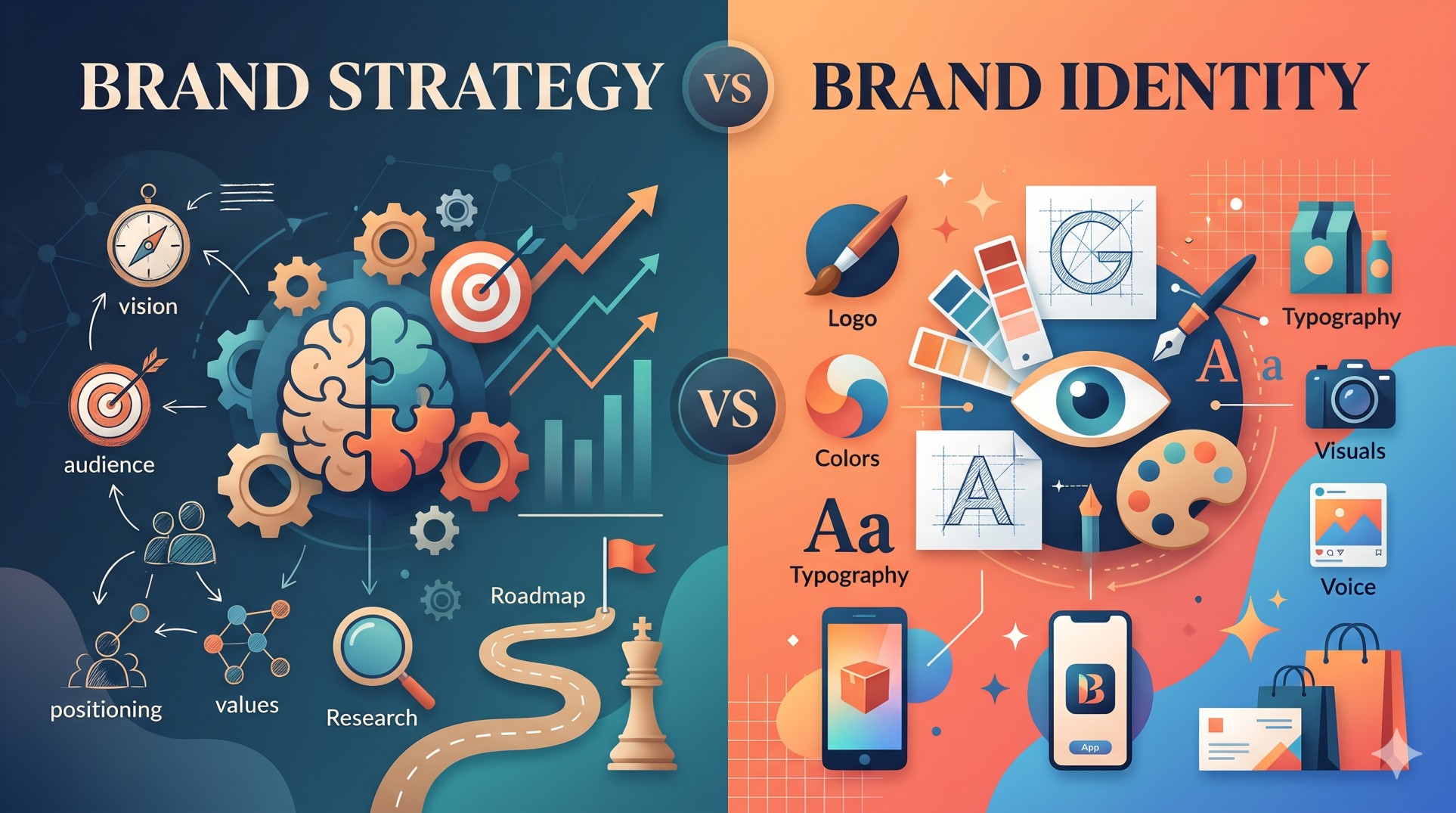
Brand strategy defines who you serve, what you stand for and why customers should choose you. Brand identity is how that thinking looks and sounds, including your logo, colours, typography and tone of voice. Strategy comes first and identity follows. Reversing the order is why many rebrands look polished but change very little for the business.
Many clients start a project by asking for a new logo, when what they actually need is clarity. The confusion around brand strategy vs brand identity is understandable, because both describe parts of one system and are often sold together. They solve different problems, though, and treating them as a single task leads to wasted budget and inconsistent results. This guide explains each term in plain language, compares them side by side and walks through a simple before and after example. If you are considering professional brand development, it will help you brief the right people and ask better questions.
Brand strategy is the long-term plan that shapes how a business is perceived and why it exists beyond making sales. It answers questions such as who the ideal customer is, what problem the business solves better than others, and which values guide its decisions. A strategy itself is not visual. It is written down as decisions, language and guidelines that teams can use every day, from hiring to product launches.
A working strategy usually covers these areas:
Brand identity is the set of visible and audible assets that express the strategy. It is what people actually see, read and hear when they meet your business. A strong identity is consistent, recognisable and built to work across a website, packaging, social media, presentations and print. Its job is to make the strategy tangible, not to replace it.
Typical identity components include:
Together these form the visual and verbal toolkit. A website is often where the identity is tested hardest, since every element is used at once. A website design team needs both the strategy and the identity in place to make confident decisions.
Brand strategy and brand identity are closely linked but do different jobs. Strategy answers who the brand is and why it matters, while identity answers how it looks and sounds. Here is how they compare:
Think of strategy as the blueprint and identity as the finished building. Both matter, but the blueprint has to exist before construction starts.
Brand positioning is one part of strategy, and it is the piece most often mistaken for identity. Positioning is a statement about the space you want to own in the market, for example being the most approachable option in a formal industry. Identity is how that idea is shown. When discussing brand positioning vs identity, a useful test is to ask whether the item could be written in a document without any design. If it can, it belongs to strategy. If it needs a visual or a typeface to exist, it belongs to identity. For a deeper look at the strategic side, this guide on building a distinctive brand positioning statement covers the process step by step.
Putting strategy before design is not a matter of preference. It is a practical way to reduce risk. Designers can produce attractive options endlessly, but without a clear brief there is no way to judge which option is right. Strategy gives everyone a shared filter for decisions. It also keeps projects on schedule, because fewer revisions are needed when the goals are agreed early.
Skipping the thinking usually shows up in predictable ways:
Consider a fictional accounting firm for freelancers, used here purely as an illustration.
The firm commissions a logo and website first. The designer chooses a navy and gold palette and a serif typeface, because these colours suggest trust in finance. The result looks professional but nearly identical to every other accountancy in the area. The tagline is generic, the website copy lists services without a point of view, and clients cannot explain why they should pick this firm over another.
This time the firm starts with strategy. Research shows its ideal clients are first-time freelancers who feel intimidated by tax rules. The positioning becomes plain-English accounting for people who hate paperwork. Values include clarity, patience and honesty, and the messaging avoids jargon entirely.
Only then does design begin. The identity uses warm colours, friendly illustration and a conversational tone of voice, because those choices express the strategy. The website explains each step in simple language. Clients now describe the firm as the approachable one, which is exactly the position it set out to own.
The business did not change. The thinking behind the brand did, and the identity finally had a reason for every choice.
In practice the two are connected by a simple chain. Strategy produces a brief, the brief guides the identity, and the identity is applied to every touchpoint. When a new question appears, such as how a social post should sound or which image suits a campaign, the team looks back to the strategy for the answer.
Brands that connect strategy and identity well tend to show the same traits:
This consistency builds recognition over time, which is ultimately what both disciplines are trying to achieve.
Most businesses need both, but the starting point differs. If your team struggles to explain what makes the business different, or if messaging feels inconsistent, start with strategy. If the strategy is clear but your materials look dated or disconnected, an identity refresh is the better next step. It also helps to audit what exists already, since some businesses have a solid strategy hidden in their heads that has never been written down. A rebrand usually involves both, in that order.
The difference comes down to thinking versus expression. Strategy decides what the brand stands for, and identity shows it consistently. Keeping them distinct makes briefs clearer, feedback more objective and results easier to measure. If you would like to discuss where your own brand stands, the team at Curious Brand, a London branding agency, is happy to talk it through. You can contact us to start the conversation.
No. Strategy defines the thinking, including audience, positioning and values. Identity is the visual and verbal expression of that thinking.
Strategy. It gives designers the information needed to make choices that can be explained and defended.
Yes. Positioning is one component of strategy, alongside audience research, values and messaging.
Timelines vary with the size of the business and the amount of research involved, but it often takes several weeks rather than days.
Yes, if the strategy still holds true. A refresh can modernise visuals while keeping the same positioning and message.